

Emily Carter, Beauty Editor.
It’s half past seven, the heating’s been on all night, and the fringe has gone flat against your forehead again. You reach for the can that’s been sitting on the bathroom shelf since last winter, give it a shake, and spray the way you always do: straight at the roots, close up, hoping for the best. Ten minutes later it still looks greasy, or worse, grey and powdery, and you’re googling “dry shampoo not working” while already running late.
Most dry shampoo disappointment has nothing to do with the product. It’s technique. The can you’re using probably works perfectly well: it’s the distance, the timing, and the brushing-out that let it down. A 2021 survey cited by Good Housekeeping found that a majority of women apply dry shampoo incorrectly, spraying too close and brushing out too soon, which is largely why so many people think they need to buy a new one.
This piece won’t ask you to spend anything. It’s about getting the bottle you own to do what it was designed to do.
- Distance and timing matter more than brand: holding the can 25 to 30cm from the scalp and waiting a full two minutes before brushing changes the result more than switching products does.
- Application the night before beats a rushed morning spray: giving the powder time to absorb overnight lets it work into the oil rather than sitting on top of it.
- Brushing technique removes the white cast: a natural-bristle brush worked in sections lifts excess powder that a quick hand-shake never shifts.
What Dry Shampoo Is Actually Doing To Your Hair
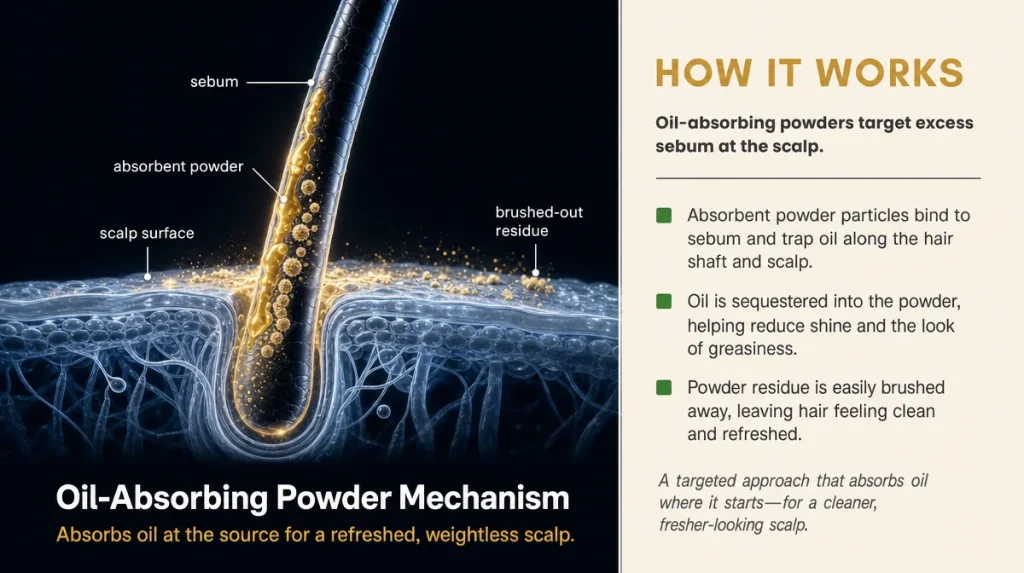
Dry shampoo is not cleaning your hair. It never has been. It’s a powder, usually rice starch or a similar absorbent, that soaks up the oil sitting on the scalp and at the root, the way a flour-dusted worktop soaks up spilled butter before you wipe it away. The flour doesn’t make the worktop clean, it just makes the grease easier to lift off.
That distinction matters because it explains most of the complaints people have. If the powder sits on top of oil rather than absorbing into it, you get a grey cast and a gritty feel, because you’re essentially looking at flour on a buttery surface rather than flour that’s done its job and been brushed away.
Understanding this changes how you use it. You’re not trying to coat the hair, you’re trying to target the oil, which means application has to be precise rather than generous.
Spraying At The Right Distance
The single biggest technique error is spraying too close. Most people hold the can an inch or two from the roots, the way they’d apply hairspray, which delivers a concentrated blast of powder to a small area rather than a fine, even dusting across the scalp.
Hold the can roughly 25 to 30cm away, about the length of a hairbrush held end to end from your scalp. At that distance the spray disperses into a light mist rather than a wet-feeling concentration, which is usually what causes the visible white residue people complain about.
Section the hair as you go. Parting into four or five sections and spraying along each parting, rather than spraying over the whole head at once, means the powder reaches the scalp rather than landing on the hair’s surface, where it does very little.
A quick self-test: spray a section, then run a finger along the parting. If you feel a damp or chalky coating rather than a fine dust, you’re too close.
Why Waiting Matters More Than Most People Realise

The oil-absorbing process is chemical, not instant. The starch needs contact time with the sebum before it can do anything useful, in roughly the same way a stain needs a few minutes of soaking before a stain remover actually lifts it rather than smearing it about.
Most people spray and brush out within thirty seconds, which doesn’t give the powder time to absorb anything. Two minutes is a reasonable minimum; longer, if you can manage it, works better still.
This is where overnight application earns its reputation among hairdressers. Applying a light dusting before bed, rather than first thing in the morning, gives the powder several hours of contact time with the scalp’s natural oil production overnight, so by morning there’s genuinely less oil to deal with, not just powder sitting on top of it.
If you’re short on time in the morning, doing even a rough version, two minutes with a hairdryer on a cool setting after spraying, speeds up the same process by helping the powder disperse into the hair rather than clumping on the surface.
The Brushing-out Step Nobody Does Properly
Brushing out is where most of the visible residue problem actually gets solved, and it’s the step people rush most.
A natural-bristle brush, the sort sold in most chemists for exactly this purpose, distributes and removes powder more effectively than a paddle brush with plastic bristles, because the natural bristle picks up fine particles rather than just pushing them around the hair shaft.
Work in the same sections you used for application. Brush from root to tip, turning the brush slightly at the root with each stroke to lift rather than flatten the hair. This does two things: it physically removes excess powder, and it redistributes the natural oil further down the hair shaft, which is partly what gives freshly washed hair its shine.
A mistake worth naming: brushing only at the crown, where the greasiness shows most, and ignoring the sides and nape. Oil builds evenly across the scalp even if it shows unevenly, so an even brush-through matters more than spot-treating the obvious bits.
If residue persists after a thorough brush, a flannel or microfibre cloth, pressed gently against the roots rather than rubbed, will lift what the brush leaves behind without disturbing the style.
Judging Whether It’s Actually Worked
The test isn’t whether hair looks freshly washed, because dry shampoo was never going to achieve that. The test is whether the roots have regained some lift and the shine has dulled to a matte finish rather than looking slick.
Run fingers through the roots about ten minutes after brushing out. If they come away feeling dry rather than coated, the product has absorbed the oil it was meant to. If a faint white film remains visible in brighter light, such as daylight through a window rather than bathroom lighting, that’s usually under-brushing rather than over-application, and a further minute with the brush will generally clear it.
Results vary by hair colour and thickness. Fine, light-coloured hair shows residue more readily but also absorbs the powder’s effects faster; thick, dark hair hides any white cast but may need a slightly heavier first application to reach oil sitting deeper in denser roots. Neither is a fault of the product itself; it’s simply a different starting point.
What’s Genuinely Different Between Formulas, And What Isn’t
Not every dry shampoo claim is marketing noise, but a good deal of it is. Tinted versions, designed to match darker hair colours, do solve a real problem: plain white powders show up visibly against brunette or black hair until fully brushed through, and a tinted formula reduces that initial cast. That’s a genuine difference, not a gimmick.
Claims about “volumising” or “texturising” beyond the basic oil-absorbing function are mostly about the same starch doing the same job, with added starch content giving slightly more grip at the root. Marie Claire UK’s beauty desk has noted that most dry shampoo formulas share a near-identical base of rice or corn starch, with the differences lying mainly in fragrance and propellant rather than performance.
Fragrance is worth a mention on its own. It masks the need for an actual wash rather than addressing it, and relying on scent alone as a signal of “clean” hair for more than two or three days running tends to leave a build-up of product that a wash will eventually need to shift all at once.
How Often Is Too Often
There isn’t a fixed rule, but there is a sensible range. Most hairdressers suggest using dry shampoo on no more than two or three consecutive days between washes, partly because the scalp still produces oil underneath the powder, and layering fresh applications on top of old residue is what leads to the build-up and occasional itchiness some people report.
Central heating makes this more noticeable in winter. Damp outdoor air followed by dry indoor heat tends to dehydrate the scalp more than cold alone, which can paradoxically increase oil production as the scalp compensates, meaning some people find they need dry shampoo more often in January than in a mild September, not because their hair has changed but because the indoor climate has.
If the scalp starts to feel tight, flaky or itchy, that’s usually a sign of build-up rather than a reason to apply more. A proper wash, rather than another dusting of powder, is the only real reset at that point.
Key Takeaways
Technique accounts for most of the difference between a dry shampoo that works and one that doesn’t. Hold the can at arm’s length rather than close to the scalp, give the powder at least two minutes before brushing, and use a natural-bristle brush worked through in sections rather than a quick once-over. Applying the night before, where routines allow, gives the formula hours rather than minutes to do its job. None of this requires buying anything new.
A Quick Checklist For Next Time
- Hold the can roughly 25 to 30cm from the scalp, not closer
- Section the hair and spray along partings rather than all over
- Wait at least two minutes before touching the hair
- Brush root to tip in natural-bristle strokes, section by section
- Check results in daylight, not bathroom lighting
- Limit use to two or three days between proper washes
- If residue persists, it’s usually under-brushing, not the product
This article is general information and does not replace advice from a trichologist or hairdresser about your individual hair type.
Individual results vary with hair thickness, colour and scalp condition.