


Priya Nair, Staff Writer.
There’s a particular kind of frustration that sets in around 3pm: the cardigan stays on, the arms stay down, and the bathroom cabinet is still full of half-used bottles promising 48-hour protection. Most people assume the answer is a stronger formula or a different scent. The more useful fact, the one dermatology researchers keep returning to, is that antiperspirants work by temporarily plugging the sweat duct itself, not by masking what comes out of it. Get the timing and the method right and a perfectly ordinary antiperspirant from the chemist can outperform an expensive one applied the wrong way. This guide sets out how the mechanism actually works, where most routines go wrong, and how to judge honestly whether what’s in your bathroom cabinet is working or just familiar.
- Timing matters more than strength: applying antiperspirant to dry skin at night, well before any sweating starts, is what allows the active ingredient to actually plug the duct.
- The active ingredient does the work, not the fragrance: aluminium salt concentration and contact time with dry skin determine effectiveness, not scent strength.
- Give a routine 48 hours before judging it: switching products every few days is the single biggest reason people believe nothing works.
What Antiperspirant Is Actually Doing Under Your Arm
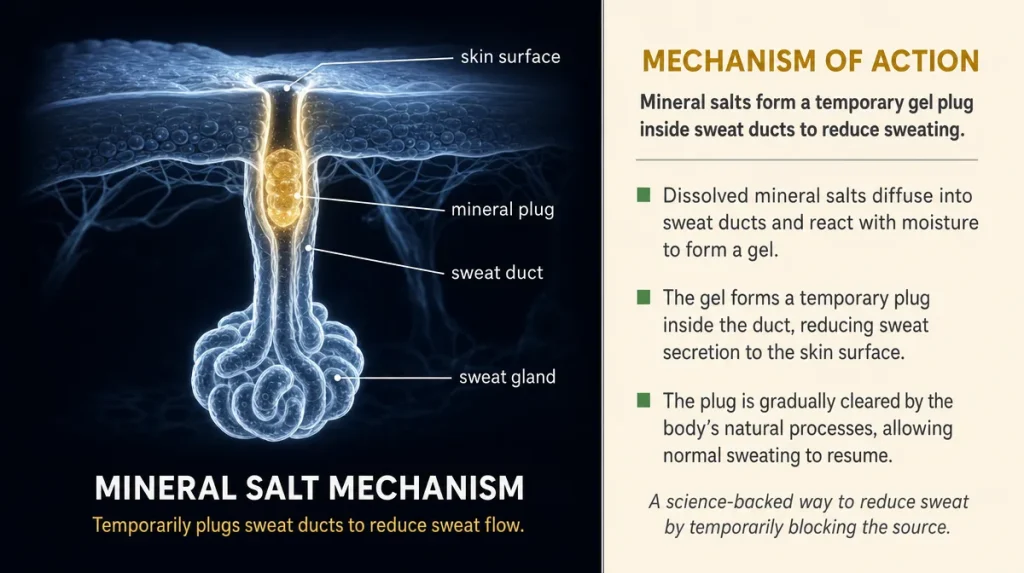
Sweat itself has almost no smell. Bacteria on the skin surface break it down, and that’s what causes odour. Deodorant tackles that stage: it masks or neutralises the smell bacteria produce. Antiperspirant does something different and more mechanical. Its active ingredient, usually an aluminium-based salt, dissolves in moisture on the skin and forms a temporary gel plug inside the opening of the sweat duct. Think of it as a drain fitted with a soft, temporary stopper rather than blocked permanently: the plug sits in the top of the duct, slows the flow of sweat reaching the surface, and is gradually washed or worn away over the day, which is why reapplication is needed.
This matters because it explains why antiperspirant has to be applied to completely dry skin to work at all. If the skin is damp from a shower, or sweat is already present, the salt can’t form a stable plug. It just sits on wet skin and rinses away or smears onto clothing without ever reaching the duct opening.
A 2021 review in the British Journal of Dermatology noted that aluminium chlorohydrate and aluminium zirconium compounds remain the only ingredients with consistent clinical evidence for reducing sweat volume, as opposed to simply masking odour. Everything else on the shelf, from charcoal to baking soda formulations, works on smell rather than sweat itself, which is a reasonable thing to want, but it is not the same job.
Why Applying It After Your Morning Shower Undoes The Whole Routine
Most people apply antiperspirant straight after their morning shower, while the skin is still slightly damp from the towel and about to go through a day of minor heat and movement. This is close to the worst possible moment for the chemistry to work.
The better method, backed by the mechanism above, is to apply at night, to completely dry underarm skin, after washing but well before bed. Overnight, sweat production is naturally lower, body temperature drops, and the skin has hours of undisturbed contact time for the mineral plug to form properly in the duct. By morning, the plug is already in place, and a light reapplication after the morning shower, once skin is fully dry again, reinforces it rather than starting from zero.
This single change, moving application to the evening, is the one adjustment that dermatological researchers most consistently point to when people say a product stopped working. It usually hasn’t. It was never given the chance to start.
A short self-test: tonight, dry the underarm thoroughly with a towel, wait a few minutes for any residual dampness to evaporate, then apply. Compare how the next afternoon feels against a normal morning-only routine. Most people notice a difference within two to three days, not instantly, because the skin’s surface needs a few applications to build up a stable layer.
Reading A Label Without The Marketing Noise
Packaging in this category leans heavily on words like ‘clinical strength’, ’48-hour protection’ or ‘advanced formula’, most of which are marketing categories rather than regulated terms with a fixed meaning. What actually varies between products, and what’s worth reading for, is the concentration and type of aluminium compound listed in the ingredients, usually as aluminium chlorohydrate, aluminium zirconium tetrachlorohydrex glycine, or similar.
Higher concentrations and the zirconium-based compounds tend to show stronger sweat reduction in clinical measurement, according to the kind of comparative testing Which? has carried out on personal care products over the years, though individual skin tolerance varies considerably and a stronger formula is not automatically the right choice for everyone.
Fragrance, colour and the presence of alcohol are largely about sensory experience and shelf appeal. They are not irrelevant, particularly for people with reactive skin, but they tell you nothing about how well the product will control sweat. A useful habit: turn the bottle around before buying and look past the front label’s claims to the actual ingredients list, the way you might when comparing two tins of soup in Boots or Superdrug rather than trusting the front of the packet alone.
The Patch Test Most People Skip
Underarm skin is thin, often freshly shaved, and sits in a warm, enclosed area, all of which make it more prone to irritation than most other parts of the body. Switching to a new antiperspirant, particularly a higher-strength one, without testing it first is one of the more avoidable causes of redness, stinging or small bumps.
A simple patch test: apply a small amount to a clean patch of inner forearm skin, not the underarm itself, and leave it uncovered for 48 hours, checking at intervals for redness, itching or swelling. If nothing develops, the product is reasonably unlikely to cause a reaction under the arm, though the warmer, enclosed environment there means some mild sensitivity can still show up that wouldn’t on the forearm.
This matters more in winter. Damp British winters combined with central heating indoors tend to dry out skin generally, including underarm skin, making it more reactive to active ingredients than it might be in a milder, more humid stretch of the year. A product tolerated well in July may sting slightly in January, not because the formula changed, but because the skin barrier did.
Mistakes That Make A Perfectly Good Product Look Like It Has Failed
A handful of habits account for most of the disappointment people report with antiperspirant, and none of them are really about the product itself.
Applying it over broken or recently shaved skin is one. Shaving creates micro-abrasions, and applying an aluminium-based product straight afterwards can sting and, in some cases, reduce how well the plug forms, because the skin surface is compromised rather than intact. Leaving even twenty minutes between shaving and application makes a visible difference.
Over-washing the area with strong soap is another. Antiperspirant needs a few hours of undisturbed contact to do its job, and scrubbing it off with a flannel during a shower, even an evening one, before the plug has set, resets the process.
Switching products too frequently is probably the biggest one. Each new formula typically needs 48 hours and sometimes up to a week of consistent use before the skin and the product settle into a stable pattern. Chopping and changing every few days, chasing a scent or a different bottle shape from the shelf at Marks & Spencer beauty halls or Look Fantastic, means never giving any single product a fair run.
How Long To Wait Before Deciding Something Isn’t Working
Patience with this category is oddly specific. The mineral plug effect can be felt within a single application, but the fuller picture, how a product performs across a warm commute, a stressful meeting and an evening out, needs a longer trial.
A reasonable benchmark: commit to one product, applied correctly at night to dry skin, for a full week before judging it. Note not just whether you stayed dry, but under what conditions you didn’t: after exercise, during a particularly warm day, after drinking alcohol or caffeine the night before, all of which genuinely increase sweat output regardless of the antiperspirant used.
If, after a week of correct application, there’s still noticeable breakthrough during ordinary daily activity, that’s a reasonable point to consider a higher-strength or differently formulated option, or to raise persistent, heavy sweating with a GP, since excessive sweating, known clinically as hyperhidrosis, is a recognised condition with its own treatment pathways separate from over-the-counter antiperspirant use entirely.
What To Layer On Top, And What To Leave Alone
Antiperspirant does one job well: reducing how much sweat reaches the skin’s surface. It does not control the temperature of the microclimate under a synthetic blouse on a packed train, and fabric choice makes a measurable difference alongside it.
Natural fibres such as cotton and wool absorb moisture and allow some air movement, whereas tightly woven synthetics can trap both heat and sweat against the skin, increasing how hard the antiperspirant has to work. This is particularly relevant under coats in a damp British winter, when central heating indoors and cold, wet air outdoors create constant temperature swings that make the body sweat to regulate itself, separate from exertion or anxiety.
Layering talc-free powder over a fully dry, already-applied antiperspirant can help absorb surface moisture through the day without interfering with the mineral plug underneath, though it is a finishing step, not a substitute. What doesn’t help is reapplying antiperspirant itself multiple times during the day over already-damp skin: as covered earlier, it needs dry skin to form the plug, so a lunchtime top-up on sweaty skin mostly sits on the surface rather than doing any further work.
Fitting The Routine Into Real Life
A routine only works if it survives real mornings: a missed alarm, a shared bathroom, a coat pulled on before the kettle’s boiled. The night-time application habit described earlier is the part most worth protecting, because it does the heavy lifting chemically, and it’s also the easiest to fit around a bedtime routine that already includes brushing teeth and removing make-up.
Stock levels matter more than people think. Running out mid-week and reaching for whatever’s left in a drawer, often an old deodorant rather than an antiperspirant, breaks the consistency that plug formation depends on. Keeping a spare in the bathroom cabinet, picked up when it’s on offer at the chemist rather than at the point of running out, removes one common failure point.
Finally, it’s worth revisiting the choice seasonally rather than assuming one formula suits all twelve months. A product that felt entirely adequate through a mild September can feel insufficient the moment central heating goes on and the skin barrier dries out, or during a rare hot stretch of British summer when SPF and sweat management both become daily considerations rather than occasional ones.
Key Takeaways
- Antiperspirant works by temporarily plugging the sweat duct with a dissolved mineral salt, not by masking odour the way deodorant does.
- Apply to completely dry skin at night for the plug to form properly; a morning-only routine on damp skin undermines the chemistry before it starts.
- Judge a new product over a full week of correct use, not a single disappointing afternoon, before deciding it doesn’t work.
- Patch test new or stronger formulas on the inner forearm for 48 hours, particularly in winter when central heating and damp air leave skin more reactive.
- Persistent, heavy sweating that doesn’t respond to correct antiperspirant use over several weeks is worth discussing with a GP rather than solving through stronger shop-bought formulas alone.
A Simple Weekly Checklist
- Apply antiperspirant to dry skin at night, not straight after a morning shower.
- Leave at least twenty minutes between shaving and application.
- Keep a spare in the cabinet so a gap in supply doesn’t interrupt the routine.
- Note any days with breakthrough sweating and what you were doing, rather than switching products on a hunch.
- Reassess the formula seasonally, particularly when central heating comes on or during a hot spell.
This article is for general information and does not replace personalised medical advice.
Individual results vary and the self-tests described here are not a substitute for a dermatologist consultation.