

David Ogden, Senior Health and Science Editor.
There is a particular kind of mirror moment most women know: lunch is over, the lipstick that promised ten hours is gone from the centre of the lips, feathered at the corners, and sitting instead on the rim of a coffee cup. The bathroom cabinet fills up with half-used tubes bought on the strength of a label, and the question typed into a search bar late at night is usually some version of why does my lipstick disappear by lunchtime. The honest answer has little to do with luck or lip shape. Long-wear colour works through a specific bit of chemistry, a thin flexible film that sets on the lip rather than a pigment that simply sits there, and once you understand how that film behaves, you can judge any formula on a shelf in Boots or Superdrug without needing a single brand name to guide you. This piece is about building that judgement for yourself.
- Transfer-resistance comes from a plastic-like film, not from pigment strength, so a shade that looks intensely bold can still rub off if the film itself is weak.
- Comfort and staying power pull in opposite directions, and the formulas that feel weightless are rarely the ones still intact after a meal.
- A proper wear-test takes a full day, not a swatch on the back of your hand, because heat, saliva and friction behave nothing like still air.
- Boxing Day sales matter more than Black Friday to older readers
Reading Past The ‘Long-wear’ Label
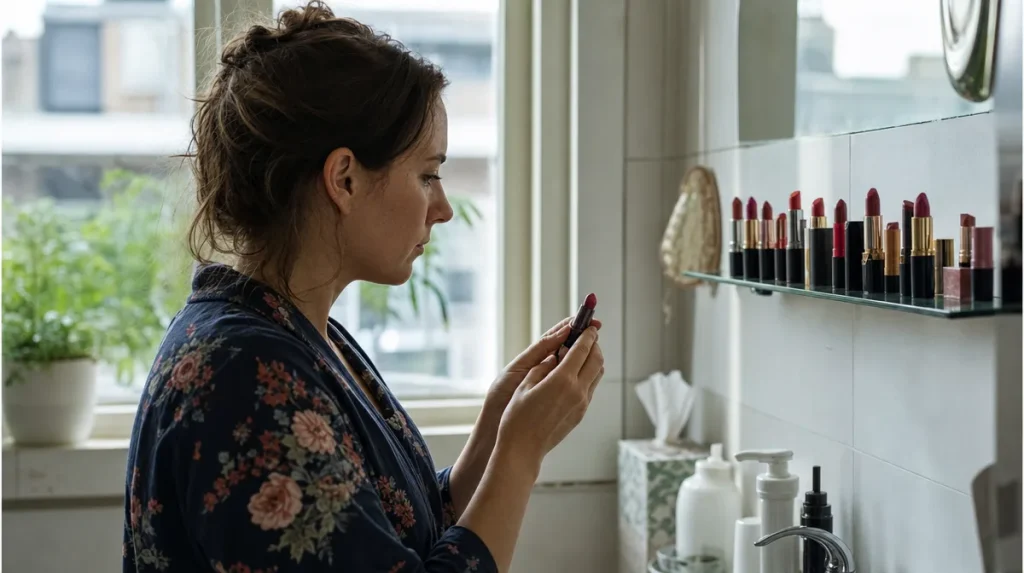
Packaging does a great deal of quiet persuasion before you have even opened the cap. Phrases like “all-day wear” or “transfer-proof” are marketing shorthand, not measured claims, and no regulator requires a brand to prove them against a clock.
Awards stickers tell a similar story. A Stylist Beauty Awards badge or a Cosmopolitan UK Holy Grail stamp signals that a formula was popular with a panel of testers at one point, which is worth something, but it is not the same as a controlled comparative test. For that kind of rigour, the closest thing Britain has is the lab-scored, red-logo tradition that Which? has run since 1957, comparing products on identical terms rather than vibes.
The practical habit worth building is simple: treat every word on the front of the tube as a hypothesis, not a fact, and look instead for what is printed in small type on the back, where the actual list of film-forming and solvent ingredients sits. That list, not the headline claim, is what will tell you whether the lipstick in your hand is built to last through a sandwich or only through a selfie.
Finding Your Undertone In Daylight
Shade-matching under shop lighting is one of the most reliable ways to buy the wrong colour. Fluorescent strip lighting flattens warmth and cool in a way that daylight never does, which is why the advice shared across British beauty journalism, including in the pages of British Vogue, is to always check a swatch by a window before deciding.
The mechanism is straightforward: your skin’s undertone (the warm yellow, cool pink, or neutral balance beneath the surface) shifts how any pigment reads once it is on your lips, sometimes pulling a berry shade towards brown or a red towards orange.
A quick self-test: look at the veins on the inside of your wrist in natural light. Greenish veins generally point to a warm undertone, bluish veins to cool, and a mix of both to neutral. Swatch a stripe of colour on the back of your hand, step towards a window, and compare it against that same patch of skin. If the colour looks muddy or chalky rather than simply bright, it is usually an undertone mismatch rather than a fault with the formula itself.
How These Formulas Actually Set
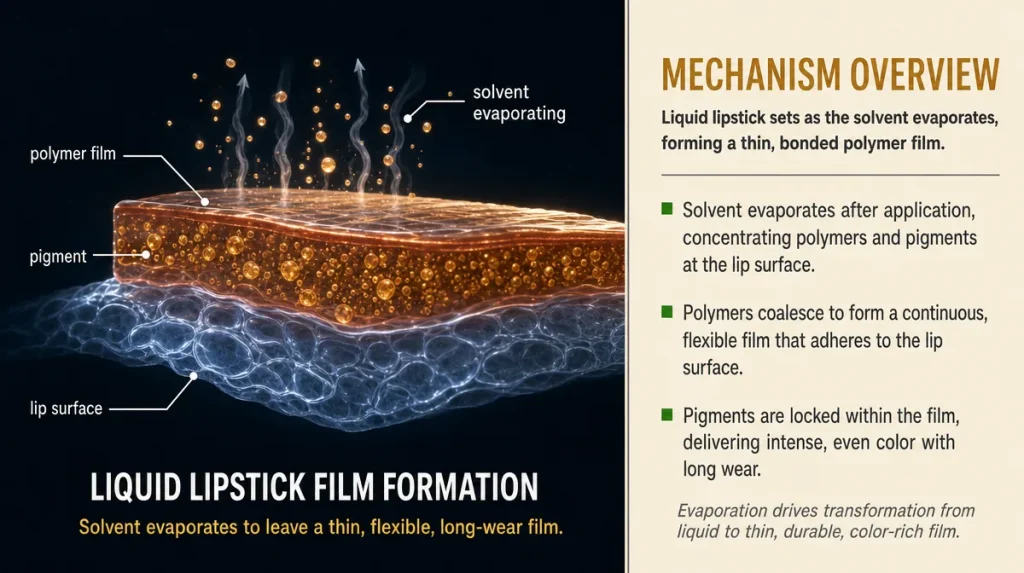
Long-wear liquid lipstick works nothing like a traditional cream bullet. Most formulas suspend film-forming polymers and pigment in a fast-evaporating solvent. Once applied, the solvent evaporates within a minute or two, leaving behind a thin, flexible plastic-like film bonded to the surface of the lip.
The household analogy that holds up best is a coat of matt paint drying on a wall: wet, it is workable and can be moved around; once it flashes off, it sets into a fixed layer that resists being wiped away, though it can still crack if the surface beneath it flexes too much.
That is precisely why these formulas feel tacky or stiff for the first sixty seconds and then suddenly “lock” into place. It also explains why reapplying on top of a half-worn layer often looks patchy: the new liquid cannot bond evenly to an already-set film the way it would to bare skin. Letting each layer dry fully, rather than building colour in one thick pass, is the single biggest difference between a finish that lasts and one that flakes by mid-afternoon.
The Comfort Trade-off Nobody Mentions
Every long-wear formula is a compromise between two things that do not naturally sit together: a film rigid enough to resist transfer, and a film flexible enough not to feel like cling film on the mouth.
A 2019 study in the International Journal of Cosmetic Science looking at film-forming lip formulations found that higher polymer concentrations, which improve transfer-resistance, were also associated with greater reported dryness and a stiffer feel on the lips over several hours of wear. In other words, the more a formula resists your coffee cup, the more likely it is to also resist natural lip movement.
This is worth knowing before you fall for a formula described as “weightless” and “ten-hour wear” in the same sentence. Some brands manage a reasonable middle ground by including emollient oils that soften the film without fully breaking it down, but a genuinely featherlight texture and genuinely all-day staying power rarely arrive together. Deciding which quality matters more for your day, an important meeting versus a long dinner, is a more useful filter than any claim on the box.
Patch-testing Before You Commit
Lip skin is thinner and more absorbent than the skin on the back of your hand, and long-wear formulas tend to carry a higher concentration of solvents and film-formers than ordinary lipstick, which is why sensitivity reactions are not unusual.
General safety guidance shared by bodies such as the British Beauty Council recommends patch-testing any new cosmetic formulation, including lip products, on a small area of skin, such as the inner arm, and waiting around 48 hours before applying it to a more sensitive area like the lips. It is a five-minute habit that catches most reactions before they reach your face.
Signs worth watching for include tightness, flaking beyond the usual dryness, or a faint stinging sensation on application, which may indicate sensitivity to a specific solvent rather than a fault with the shade. If a new tube causes any of these, a pharmacist at your local chemist can usually advise on a suitable soothing balm and help you work out which ingredient may be the culprit. Keeping a short note of what caused a reaction, even just a photo of the ingredients list, makes it far easier to avoid repeating the mistake with a different brand carrying a similar formula.
Application Technique That Actually Extends Wear
The single biggest mistake is applying long-wear colour the way you would a regular lipstick: one thick, even sweep, straight from the bullet to the lip.
Because these formulas rely on a film setting properly, thin layers beat thick ones every time. A first pass should be sheer enough that you can still see a hint of natural lip colour through it. Wait roughly a minute for that layer to flash off and set before adding a second, slightly fuller pass. Rushing this step is why so many people report the colour “balling up” or transferring onto a glass within the hour: the film never finished setting before it met friction.
Lining the lips first with a matching pencil, rather than skipping straight to liquid colour, also helps, because the waxier texture of a pencil gives the liquid formula a slightly rougher surface to grip rather than sliding over smooth skin.
A final, often-missed step: press a single folded tissue lightly against the lips once the last layer has set, to lift away any colour that has not properly bonded. It looks like it should remove more colour than it does. In practice it removes only the loose excess, leaving the bonded film behind and noticeably reducing transfer onto cups, masks and collars for the rest of the day.
Judging Honest Wear-time At Home
A swatch on the back of your hand tells you almost nothing about how a formula behaves on lips, which move roughly two thousand times a day through talking, eating and drinking, and sit close to saliva, heat and friction that a hand never experiences.
A fairer home test: apply the lipstick as you normally would on an ordinary day, then simply note the time. Check it after a hot drink, after lunch, and again mid-afternoon, each time comparing the centre of the lip (which touches cups and cutlery) against the outer edge (which mostly does not). Genuine long-wear formulas typically keep colour visibly intact at the edges even once the centre has faded, because friction, not time alone, is usually what removes the film.
Writing down what you notice, even three short lines in a notes app, builds a far more reliable picture over a few wears than any single dramatic failure or success. A lipstick that survives one wedding but fails on an ordinary Tuesday of tea and toast is not actually long-wear in any meaningful sense, and this kind of ordinary-day test is the only way to tell the difference.
Caring For Lips Under A Long-wear Formula
The same film that resists your coffee cup also resists soap and water, which means removal matters as much as application. Scrubbing at set colour with a flannel tends to pull at the delicate skin of the lips rather than lift the film cleanly.
An oil-based balm or micellar formula, left to sit for ten to fifteen seconds before being wiped away, breaks down the film’s bond far more gently than friction alone. This matters more in a British winter than most people expect: damp outdoor air combined with central heating indoors dries lips out faster than cold alone, and a film-forming lipstick applied over already-dry, flaking skin will cling unevenly and look patchy within the hour rather than setting as a smooth coat.
A nightly balm, kept by the bed rather than buried in a bag, is the simplest insurance against this. Most chemists stock a reasonable own-brand option, and it is worth treating that step as part of the long-wear routine itself, not an optional extra, because the condition of the lips underneath the film is doing at least as much work as the formula on top.
Key Takeaways
Long-wear performance is a question of chemistry, not confidence on a label. The film-forming polymer is what resists transfer, thin layers applied with patience set better than one thick coat, and comfort nearly always trades off against staying power to some degree. Shade-matching in daylight prevents more disappointment than any formula choice, and a fair wear-test runs across a full ordinary day rather than a single swatch on the hand.
A Quick Checklist Before You Buy
- Check the ingredients list on the back, not the claim on the front
- Swatch and judge the shade in daylight, away from shop lighting
- Patch-test a new formula on your arm 48 hours before wearing it on your lips
- Apply in thin layers, letting each one set before adding more
- Judge wear-time across a normal day of eating and drinking, not a single moment
- Remove gently with an oil-based balm rather than scrubbing
- Keep lips conditioned underneath the film, especially during damp, centrally-heated winters
This article is general information and does not replace advice from a pharmacist or dermatologist about your individual skin.
Individual results vary, and what suits one person’s lips may not suit another’s.